

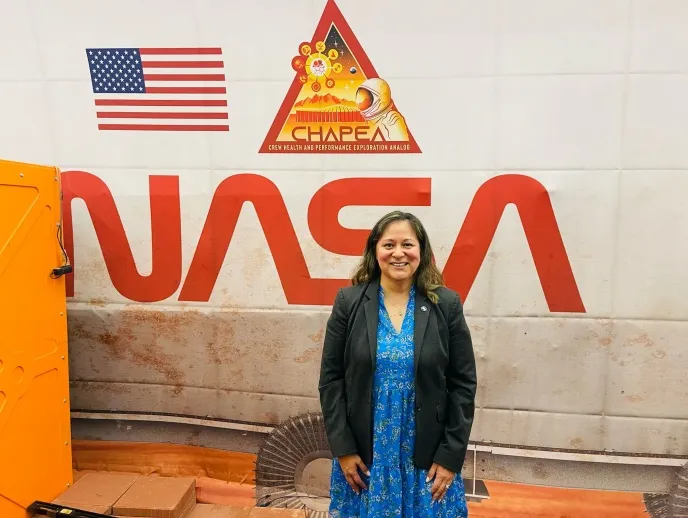
“From the Moon we are going to Mars,” affirms the Salvadoran NASA engineer
The Salvadoran engineer detailed to CNN the space exploration plans and the challenges of a future crewed mission to Mars, including astronaut nutrition.
The aerospace engineer Patricia Ortiz, of Salvadoran origin, revealed this Friday what NASA's plans are for the coming years, within a context marked by recent advancements in lunar exploration.
“From the Moon we are going to Mars,” the expert affirmed during an interview with CNN en Español, when referring to the US space agency's next major objective.
Ortiz's statements come on the same day that the Artemis II mission returns to Earth after spending 10 days in space and reaching the far side of the Moon, a key milestone in the program that seeks to pave the way for future long-duration crewed missions.
The Salvadoran worked on the Orion heat shield project, the capsule in which the Artemis II astronauts travel, a fundamental piece to guarantee the safety of the crew during re-entry into Earth's atmosphere.
Likewise, she revealed that she serves as a manager for a program that studies the nutrition of crew members who would go to Mars, whose mission will be much more extensive. “The minimum is three years,” said the engineer, explaining that a one-way trip alone would take between 6 and 9 months, then they would have a one-year stay on the “red planet,” and for the return, it would be another 9 months.
Ortiz indicated that the program she directs is responsible for searching for different food options for the astronauts, since “there is a point where if you always eat the same thing, the body no longer absorbs the nutrients.”
“When you don't eat well, you're not going to feel well mentally and physically,” she noted. “We want the astronauts to feel good on that mission.”
Can astronauts request special food?
Although most of the food taken into space is dehydrated, the engineer indicated that astronauts can bring other products that comply with NASA regulations.
In that sense, Ortiz said that the Nutella jar that appeared floating in an Artemis II broadcast, and went viral on social networks, was possibly a special request from an astronaut.
However, she noted that “everything they carry on the spacecraft is documented on a list.”
When asked what crew members could request, she replied: “the only rule is that they cannot bring something that will create a lot of crumbs,” because, as she explained, “the issue of dust in space is very delicate because (by floating) it can get into the electronics or other things and cause many problems.”